REVIEW · MILAN
e-Scavenger hunt Milan: Explore the city at your own pace
Book on Viator →Bookable on Viator
Milan is better when you wander with a mission. This e-scavenger hunt turns a self-guided city walk into a mobile, question-based game that takes you past major landmarks while you set your own pace. I like that it’s designed to work for different ages and group sizes, and I also like that it points you at places you might skip when you’re just winging it.
The best part is the balance of freedom and structure: you don’t have to sync up with a group, but you still get prompts to notice details at stops like Galleria Vittorio Emanuele II and the Milan Cathedral. One thing to consider first: this is not a classic guided tour. If you want a human guide talking the whole way, the experience may feel app-only, and the included instructions may not match what you’re hoping for.
Key things to know before you play
- You control the pace: the “tour” is really an app-led walk you can speed up or slow down.
- 2 to 4 hours is realistic: it’s long enough to enjoy several landmarks without turning into a full-day ordeal.
- It’s built around landmarks: you’ll work through points around central sights, including the Duomo area and Leonardo’s Last Supper site area.
- It’s a small-group-friendly format: priced per group (up to 6), so it can be good value with friends.
- Phone and data are on you: smartphone use and any data are not included, so charge up before you start.
- You end where you started: the route loops back to Piazza Fontana.
In This Review
- App-led scavenger hunt: how you’ll actually experience Milan
- Price and value: $36.07 per group (up to 6)
- Piazza Fontana start: the easy entry point
- Galleria Vittorio Emanuele II: shop-gallery energy, with prompts
- Milan Cathedral (Duomo) area: look up, not just at the facade
- Castello Sforzesco: a medieval fortification in plain sight
- Santa Maria delle Grazie and The Last Supper: a must-see stop, guided by the game
- Porta Sempione: city-gate landmark plus a district name
- San Fedele: Jesuit church with a clear patron detail
- Casa Panigarola (Palazzo dei Notai): historic city-center fabric
- Basilica of San Lorenzo Maggiore: Roman roots in the canal ring
- The rectangular fountain with Giuseppe Bovara: a built-in detail check
- Basilica di Santa Tecla: false apse and trompe-l’œil fun
- Brera and the Pinacoteca di Brera: art at a walking pace
- Palazzo Litta: Baroque structure near the end
- The main drawback to plan for: app-only may not fit everyone
- Who should book this e-Scavenger hunt Milan
- Should you book it?
- FAQ
- Where does the e-Scavenger hunt Milan start?
- How long does the experience take?
- What’s the price?
- Is this a private tour?
- Do I need a smartphone and data?
- What kind of ticket do I receive?
- Where does the experience end?
- Is it available every day?
- Can I cancel for a full refund?
App-led scavenger hunt: how you’ll actually experience Milan

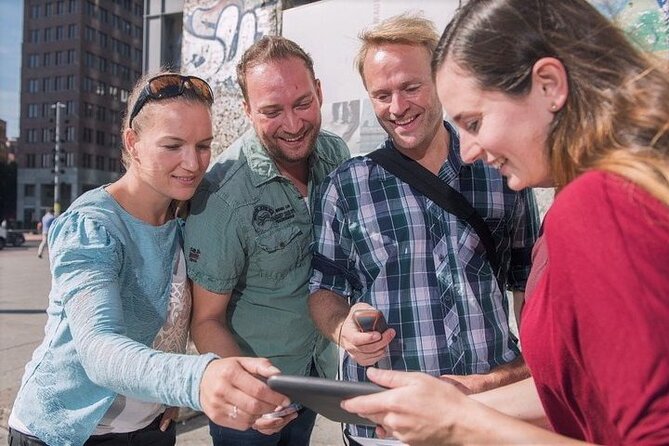
This tour is designed around an interactive game on your smartphone. You download the app, open the game, and follow the prompts as you move through Milan. The format is simple: you’ll answer questions and complete research-style assignments along the way, using the app to guide you to the next stop.
That structure matters. When you explore Milan on your own, it’s easy to drift past architectural details or miss why a place is famous. Here, the app nudges you to look more closely and connect each stop to something you’re learning in real time.
You also get a practical benefit: no waiting for a group. The tour is private for your group, and it’s meant to be family-friendly. That means you can pause for a drink, take a slower photo route, or shorten the walk if your group has different energy levels.
Price and value: $36.07 per group (up to 6)
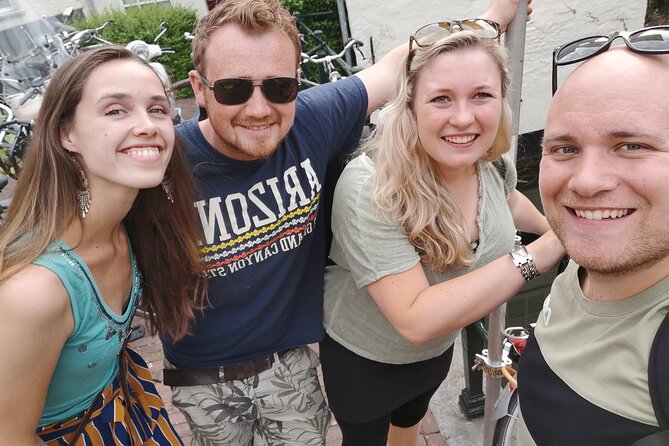
The price is $36.07 per group up to 6 people. That’s the kind of pricing that can feel fair for couples, but it can also become a bargain if you roll in with friends or family.
Why? Because the cost scales by group size, not per person. If you have the full group of 6, the effective cost comes down to about $6 per person. Even with fewer people, you’re not paying a premium for a larger group, since it’s one booking per group.
One caution: because the experience is app-led, your best value comes when everyone in your group is willing to use the phone during the walk. If someone expects a guided narration instead of game prompts, they may not get the full benefit.
You can also read our reviews of more city tours in Milan



Piazza Fontana start: the easy entry point

You start at Piazza Fontana (20122 Milano) and finish back at the same meeting point. That round-trip design helps. You’re not left hunting for a new pickup point at the end, and it makes the timing easier if you’re lining up another activity after your 2 to 4 hour window.
Piazza Fontana is also conveniently placed near public transportation, which is helpful if you’re combining this hunt with other parts of the day. The tour runs all day (12:00 AM to 11:59 PM, based on the stated operating window), so you can slot it in without stressing about a tight schedule.
Galleria Vittorio Emanuele II: shop-gallery energy, with prompts
The first major landmark you’ll work through is Galleria Vittorio Emanuele II. It’s described as Italy’s oldest active shopping gallery and a key Milan landmark. That wording is a big clue to how the app is likely to steer your attention: this isn’t just a pretty passageway, it’s still functioning as a shopping destination.
What I like about placing this stop early is that it gives you an immediate sense of Milan’s scale and style. You get a “start strong” moment where the landmark has enough visual pull that even people who don’t care much about fashion history will still enjoy wandering through.
Potential drawback: this kind of place can be busy, and shopping areas tend to be more distracting than quiet plazas. If your group gets impatient waiting for others to read clues, you might want to keep a steady pace through the galleries and save deeper photos for later.
Milan Cathedral (Duomo) area: look up, not just at the facade
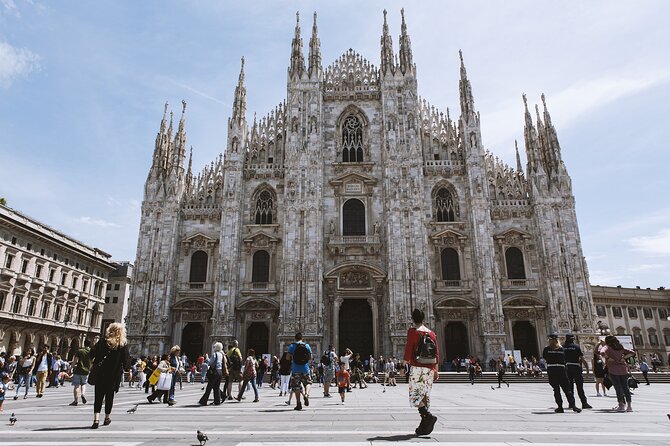
Next is the Milan Cathedral, also called the Metropolitan Cathedral-Basilica of the Nativity of Saint Mary. This is the kind of stop where most self-guided walks end up being: take a photo, move on, repeat.
Here, the app helps you slow down. The information you’re given includes specific attention points, like the idea that there are notable features on the roof and that there are striking rooftop sculptures. It also connects the area to the larger moment of Duomo Square, enclosed by the Gothic cathedral and often filled with crowds drawn by shopping.
What you’ll likely enjoy is the way the game pushes you to notice more than the main sightline. Even if you don’t spend ages studying details, the prompts give you something to focus on while you’re standing there.
Consideration: Duomo Square is shopping-heavy, so you’ll be balancing landmark viewing with the general noise and foot traffic of the area. If you prefer quiet sightseeing, plan a calmer start time or keep your clue-reading quick and efficient.
Castello Sforzesco: a medieval fortification in plain sight

Then the route turns toward Castello Sforzesco, described as a 15th-century medieval fortification in northern Italy. Even without extra narration, the castle setting changes the feel of the walk. You go from cathedral square intensity to fortress presence.
For a scavenger hunt, this is smart. Castles and fortifications naturally offer “targets” for questions: location-based clues and visual checks feel straightforward, even if you’re moving quickly.
The main catch is that a fortification area can also feel windy and exposed depending on weather. If you’re traveling in cooler seasons, a light layer can make the experience more comfortable, especially if you’re doing clue work that takes a little longer than a quick photo stop.





Santa Maria delle Grazie and The Last Supper: a must-see stop, guided by the game

One of the most famous stops is The Last Supper, described as a late 15th-century mural painting by Leonardo da Vinci. It’s housed in the refectory of the Convent of Santa Maria delle Grazie.
The tour includes Santa Maria delle Grazie as a church and Dominican convent, and it’s noted as a UNESCO World Heritage Site. That UNESCO label matters for how you think about the site. This is not just another church stop in a walking route; it’s a place with global significance.
In a self-paced game, you won’t get the benefit of a live guide explaining everything. But the app-led research assignments can still help you approach the mural area with context, rather than treating it as a quick checkmark.
Important practical note: this is an app-led experience, not a ticketed museum narration. Your enjoyment depends on what you can access during your time window. The good news is that at minimum, the route is built to bring you to the right area tied to Leonardo’s work.
Porta Sempione: city-gate landmark plus a district name
The route also includes Porta Sempione, identified as a city gate of Milan. The name also refers to the surrounding district. That detail is more than trivia. It helps you understand why the area can feel like a blend of “monument” and “neighborhood.”
For clue-solving, district-name landmarks are often useful because they can anchor where you are and what direction you’re headed next. You’re not just looking at an object; you’re learning how Milan labels and organizes space.
San Fedele: Jesuit church with a clear patron detail
Next up is San Fedele, described as a Jesuit church dedicated to St. Fidelis of Como, patron of the Catholic diocese of Como.
This kind of specific dedication detail is exactly the sort of thing that turns a sight into an assignment you can answer. If you like learning the “who/why” behind religious buildings, this stop delivers a clean thread to follow.
One consideration: churches tend to have rules about where and how you can look. Since the tour data doesn’t describe exact entry procedures or interior access, plan to be flexible. The best scavenger hunt mindset here is: use the app prompts for the outside and general viewing cues, then see what’s possible on the ground.
Casa Panigarola (Palazzo dei Notai): historic city-center fabric
You’ll also come to Casa Panigarola, also known as Palazzo dei Notai, in Piazza Mercanti, described as the former city centre in the Middle Ages. That gives this stop a different flavor than the big-ticket monuments.
This is the part of the hunt where you feel like you’re learning Milan at street level. In a classic tour, you might breeze past smaller landmark buildings. In a scavenger hunt, those “in-between” stops can become some of the most satisfying, because they’re less obvious and therefore easier to miss on your own.
Basilica of San Lorenzo Maggiore: Roman roots in the canal ring
Another stop is the Basilica of San Lorenzo Maggiore, described as a church in northern Milan. It’s located within the city’s ring of canals, and it was originally built in Roman times.
I like this stop because it adds depth to your walk. You’re not just cycling through famous names; you’re also seeing how different time periods are layered into the same urban area.
A small practical note: canal-adjacent areas can involve more surfaces and walking in open space. If you’re wearing less comfortable shoes, this is where you’ll feel it.
The rectangular fountain with Giuseppe Bovara: a built-in detail check
You’ll also encounter a described fountain feature: a rectangular fountain designed by Giuseppe Bovara. The water gushes out through three mouths—two lateral and one front.
This is perfect scavenger-hunt material. It gives you something concrete to confirm with your eyes. Instead of vague landmarks, you get a specific physical description that you can match on the spot.
If your group tends to rush, this can be a great “slow down for 30 seconds” moment to re-center everyone on the game.
Basilica di Santa Tecla: false apse and trompe-l’œil fun
A fascinating stop on the route is Basilica di Santa Tecla, described as a former paleo-Christian basilica church in Milan. The notes include that the roof is famed for statues and that the church is known for a false apse, an early example of trompe-l’œil, attributed to Donato Bramante.
Even if you’re not a lifelong art student, trompe-l’œil is the kind of concept that feels like a secret handshake with the building. The tour data gives you enough of the hook that when you look, you can connect what you’re seeing to why it’s notable.
Potential drawback: if you’re expecting lots of spoken interpretation, you may have to work a bit harder with the app prompts. The payoff is that you’re not just standing there wondering what you’re looking at.
Brera and the Pinacoteca di Brera: art at a walking pace
The route includes Brera, described as an elegant Centro Storico district home to the Pinacoteca di Brera gallery and its collection of Italian art spanning centuries, and fresco-filled.
Then you get the museum anchor: Pinacoteca di Brera, noted as the main public gallery for paintings in Milan and containing one of the foremost collections of Italian paintings.
For an app-led scavenger hunt, including an art museum area can be a double-edged sword. On one hand, art makes for great “research assignment” energy. On the other, museum time can vary depending on what you choose to do inside versus outside.
Your best approach is to treat this stop as a mood change. Even if you don’t spend long in galleries, the district itself gives you something to work with, and the app tie-in helps you orient yourself to why Brera is famous.
Palazzo Litta: Baroque structure near the end
Near the end of your walk, you’ll reach Palazzo Litta, also known as Palazzo Arese-Litta, described as a Baroque structure in Milan.
This is a helpful finale kind of stop. After a mix of religious architecture, fortification, and art-focused moments, you get one more style marker to keep your brain organized as you head back to Piazza Fontana.
If your group is dragging, Baroque facades can be visually satisfying even when you’re low on patience. The building type tends to reward quick glances.
The main drawback to plan for: app-only may not fit everyone
The biggest risk with app-led experiences is expectation mismatch. If you want a person to explain, troubleshoot, and talk you through the city, this likely won’t feel like that.
There’s also a common failure point with any phone-dependent experience: if the app guidance feels incomplete or unclear to you, the game can shrink down to just the basic play component rather than feeling like a full guided learning walk. I’d treat this as a “go in with the right mindset” tour. Come ready to interact with the phone prompts and accept that you’re doing more work yourself than on a traditional tour.
Also plan for the tech basics. The tour explicitly doesn’t include smartphone use or data. So if you show up with a dead battery, you’ll be stuck. Charge fully, and consider how you’ll handle connectivity where you’re walking.
Who should book this e-Scavenger hunt Milan
This works best if you want:
- A self-paced way to see Milan’s landmarks without negotiating with a group schedule
- A family-friendly activity that can keep kids and adults engaged at the same time
- A small-group format where you can share the phone and rotate clue-reading
It may be a poor fit if:
- You’re looking for a classic guide-led narration the entire time
- You don’t want to rely on a phone for instructions and assignments
- Your group hates games and would rather just walk freely without prompts
Should you book it?
Yes, if you’ll enjoy learning by doing. This is one of those Milan experiences where the app helps you notice more, and the loop from Piazza Fontana back to Piazza Fontana keeps it practical.
Skip it if your top priority is a human guide experience. App-led tours can still be fun, but they won’t replace the back-and-forth of a real person pointing things out and answering your questions on the spot.
FAQ
Where does the e-Scavenger hunt Milan start?
It starts at Piazza Fontana, 20122 Milano MI, Italy.
How long does the experience take?
It takes about 2 to 4 hours.
What’s the price?
It’s $36.07 per group, up to 6 people.
Is this a private tour?
Yes. Only your group participates.
Do I need a smartphone and data?
Yes. Smartphone and data use are not included.
What kind of ticket do I receive?
You get a mobile ticket.
Where does the experience end?
It ends back at the meeting point (Piazza Fontana).
Is it available every day?
The stated opening hours are Monday through Sunday, 12:00 AM to 11:59 PM (within the listed operating dates).
Can I cancel for a full refund?
You can cancel up to 24 hours in advance for a full refund. If you cancel less than 24 hours before the start time, the amount paid is not refunded.